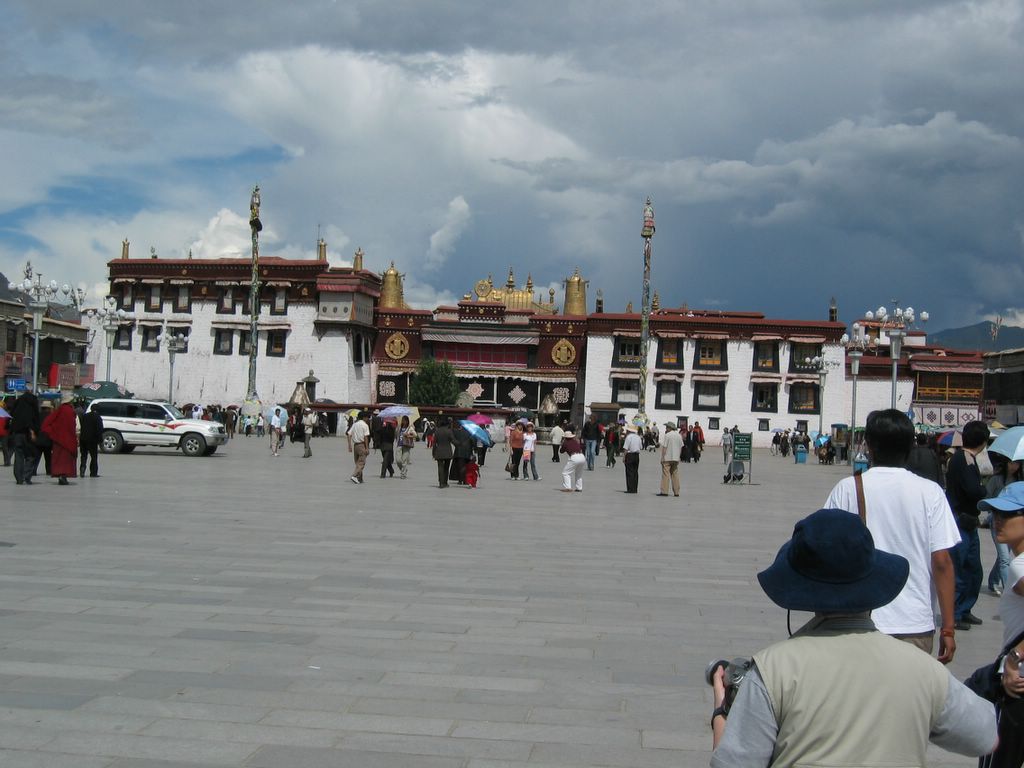
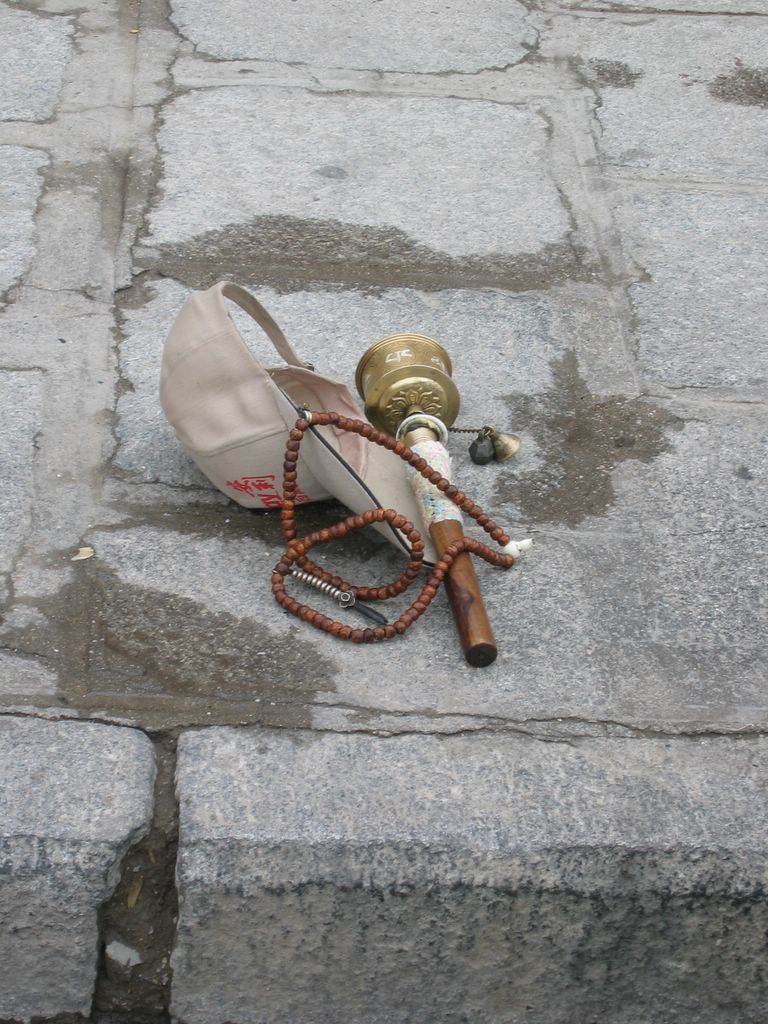
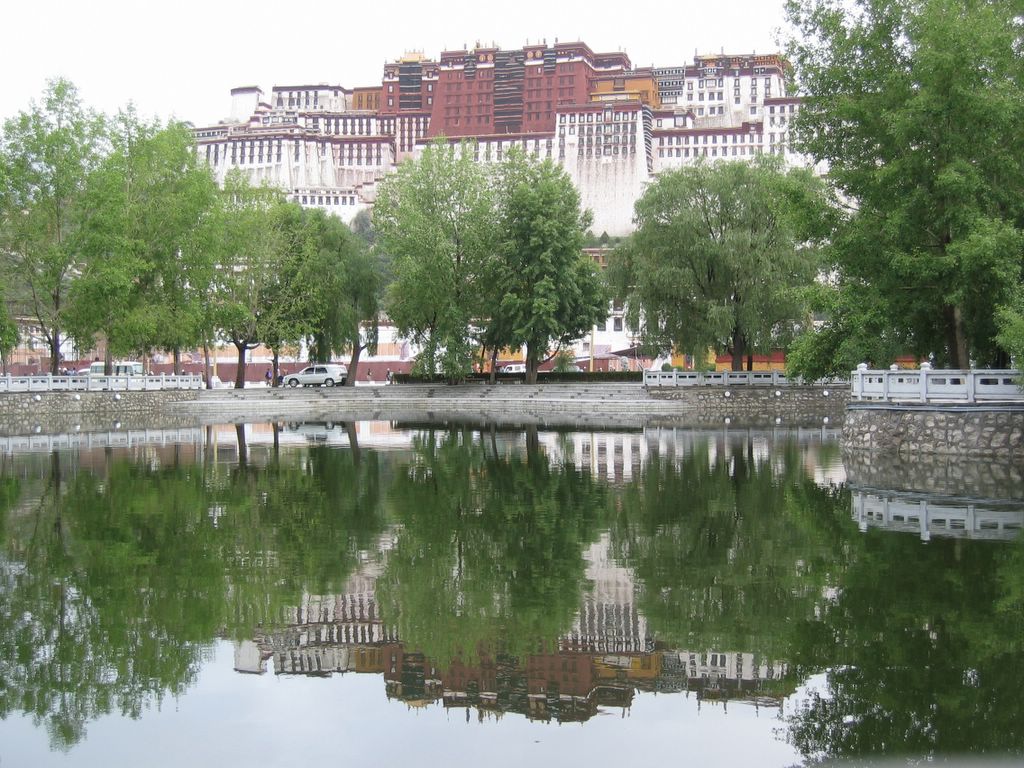
The Potala PalaceStanding loftily above the Lhasa basin, the Potala Palace is not the symbol of Lhasa alone but of all Tibet.
No journey to the "Roof of the World" is complete without a visit to the-world-famous Potala.
The thirteen-storeyed ancient building built only of mortar, timber and stone dates back 1,300 years. As well as being of great historical value, the architecture itself of the Potala, and in addition its murals, stupas, carvings, sculptures and the like are witness of its being a treasury of art. The palace contains such invaluable treasures as pearls, cultural relics, "tangkas," scrolled texts and ancient chinaware, making the Potala a repository of inestimable worth, and it is a mecca to which the visitor can return again and again, each time experiencing fresh understandings and gains.
Toiling up the stairs leading to the Potala, step by weary step, you indeed feel yourself a small and insignificant creature in the face of this gigantic palace. Arriving at the huge front entrance, the Puntsok Donam Gate, you may marvel at the great bar across the gate which is made out of an entire tree trunk. As you pass through the gate you enter a narrow passage, and then a high-walled tunnel-like corridor which allows a rare glimpse of the massive palace walls, built solely of stone and mortar and several metres thick, which date back over a thousand years.
The passage gives out onto a huge courtyard, sixty to seventy metres above ground level, which was specially built for ritual dance performances. The even, 1,600 square metre floor is paved with "arka," a special type of Tibetan flooring like concrete. Low yellow-walled galleries line the northern and southen sides of the courtyard, while directly opposite, a short but steep triple flight of steps leads up to the antechamber in the western front of the Deyangshar Mansion. The flight of steps in the centre was reserved for the Dalai Lama's sole use, while those to either side were for ordinary people and officers. This is the only way to the other halls, and it is said "a troop ten thousand strong cannot pass through the entrance though it be guarded by a single man." In the antechamber, the visitor's attention is caught by a pair of hand prints under a glass cover to the left on the southern wall. These prints were left by the Fifth Dalai Lama at the height of the construction of the Potala in the mid-seventeenth century. By then the Fifth Dalai Lama was advanced in age and did not take much interest in political affairs, so all arrangements were put in the hands of Sang-gye Gyatso, (the Desi or the Regent). But the Desi at that time did not have much prestige, and consequently the Fifth Dalai Lama, realising that people were unlikely to recongnise the Desi's authority, left the Desi prints of his own hands as a symbol of his authority over monk and lay officials in government affairs. Ever since then, these historic hand prints have been preserved.
Turning to the eastern walls, familiar murals of Songtsan Gampo asking for the hand in marriage of Princess Wencheng and scenes from her journey to Tibet can be seen. After unifying Tibet for the first time and founding the powerful Tubo Dynasty, Songtsan Gampo sent his trusted minister Gar Tongtsan to Chang'an, the capital of the Tang Dynasty, to ask the Tang Emperor Taizong for the hand of the princess in marriage. From these murals we can see a contemporary sketch map of the Tang Dynasty capital Changan, and also how emperor Taizong posed five tricky questions to test the intelligence of the envoys from neighbouring minority nationalities who had all come to the Tang Court to seek the princess in marriage. Gar Tongtsan, the Tubo envoy, being the most intelligent of the lot, succeeded in cracking all five riddles, gained first place and consequently won the hand of Princess Wencheng for the Tubo Tsanpo. Murals depicting this part of history can also be found in many other monasteries and temples.
Leading on next to the murals on the northern wall, we can see a portrayal of Princess Wencheng's journey to Tibet and the scene of great rejoicing on her arrival in Lhasa. In 710 AD, following in the footsteps of her royal sister of a previous age, another Tang princess, Princess Jincheng, made her journey to Tibet. Princess Jincheng's deeds too are portrayed in the murals of the Potala, and a painting of Princess Jincheng's journey to Tibet appears on the east wall of the Tsomchen Shar (the East Audience Hall).
The Tsomchen Shar is the largest hall in the White Palace section of the Potala. Major political and religious events such as ordinations and coronations of the Dalai Lamas were held in this audience hall. Here are preserved the gold slab and gold seal inscribed with the title offered to the Fifth Dalai Lama by emperor Shunzhi of the Qing Dynasty. The inscription reads:"Preceptor of Lord Buddha's Doctrine, Keeper of peace in the West, Uniter of the Buddhist Faith Beneath the Sky, Superior of the Ocean, Holder of the Thunderbolt."
From Tsomchen Shar if you climb up to the topmost part of the White Palace section, you will find yourself in another world. Full-length glass windows face south so that the rooms are bathed in brilliant sunshine from morning till evening. Respectively named East Sunny Room and West Sunny Room, these were the Dalai Lama's living quarters and are crammed with precious jewels, luxurious furnishings, gold basins, jade bowls, brocades and satins. Stepping out onto the balcony, Lhasa seems to be just beneath one's nose; fold upon fold, mountain ranges rear up, the Kyichu River gurgles along below, footpaths crisscross the fields and villages studded with green trees, creating a scene of genuine majesty.
The whole of the Potala is divided into two sections, the White Palace and the central Red Palace, From the very beginning , the two sections of the Potala were strictly distinguished by their different colours, being white-washed and red-washed. The Red Palace mainly consists of funerary stupas of the Dalai Lamas and various shrines and temples. There are altogether eight funerary stupas in the Potala containing the embalmed remains of the Fifth to the Thirteenth Dalai Lamas, excluding the Sixth. The funerary stupas are more or less akin to each other in structure, but they differ greatly in size, and those of the Fifth and Thirtenth Dalai Lamas are the most splendid of the lot. Built in 1690, the funerary stupa of the Fifth Dalai Lama is the largest at 14.85 metres high. It is entriely covered in sheets of gold, and studded with coutless pearls, jade and agate. 110,000 ounces of gold were used for this stupa alone, excluding the jewels.
Although the large majority of Tibetans dispose of their dead through celestial and water burials, the bodies of religious leaders who are apt to preach to others about "sacrificing one's body" are preserved for posterity. Whenever the Dalai Lama passed away, the body was smeared with salt to absorb moisture, and then anointed with perfumes. When dessicated, it was placed in a stupa. This is one kind of stupa burial. In Tibet, stupa burials are only given to the Dalai Lamas and "Hutogtu" lamas. No other monk or lay officials are permitted to be treated in this way after death. In keeping with his rank, a golden stupa is accorded only to the god-king, while others are given silver, brass and clay stupas respectively.
The shrines containing the funerary stupas lead off from the huge central Sishi Puntsok Hall, with a floor space of nearly seven hundred square metres. Displayed here is the panel presented by Qing Emperor Qianlong with its Chinese characters written in gold which read: "Holy Spot of the Emerging Lotus." The murals in this hall mainly include works of the Fifth Dalai Lama during his lifetime and events of his reign, and his famous visit to Beijing and interview with Emperor Shunzhi in the mid-seventeenth century appears conspicuously on one of the walls. The frescoed corridor on the floor above the Sishi Puntsok can be rated as an art gallery. Here, nearly seven hundred nurals are displayed covering every aspect of life of the Tibetan people and showing different scenes from the construction of the Potala.
Two storeys up from the Sishi Puntsok Hall is the Chogyal Drupug (the Cave of the Religious-king). This cave-like shrine is said to have been built to commemorate Songtsan Gampo's meditation on the Red Hill in his youth. Constructed in the seventh century, it is the most ancient part of the Potala. According to written records, when it was built 1,300 years ago, the Potala had 999 rooms, with the addition of this cave shrine making the figure up to 1,000. Formerly, the Potala was built on a vast scale, but due to fire damage caused by lightning strikes and sudden attacks, the original construction was almost levelled to the ground leaving only the Chogyal Drupug Cave and the Pagpa Lhakhang Temple. Looking around at the Chogyal Drupug's shiny walls blackened by incense smoke, you can faintly see that all four walls have been dug out to form a cave. Under the gloomy electric light, the lifelike sculptures of Songtsan Gampo, Princess wenchen, Princess Bhrikuti Devi, and Gar Tongtsan and Thonmi Sambhota could be real! This tiny cave shrine scarcely thirty square metres in area will take you back 1,300 years in history.
The Pagpa Lhakhang, on the next level directly above the Chogyal Drupug, is also one of the earliest parts of the palace. The central image enshrined inside is said to be a manifestation of Songtsan Gampo. A panel with the inscription "Blissful Soil Nourishing Miraculous Fruits' written in Chinese by the Qing Emperor Tongzhi hangs above the entrance to the shrine. From the time of the Fifth Dalai Lama, the Qing Dynasty strengthened its control over Tibet, and the Dalai Lama in return developed his relationship with the central government. Other proofs of this close relationship can be found elsewhere in the Potala, and include a portrait of Emperor Qianlong and a imperial longevity tablet written in four languages Han, Tibetan, Mongolian and Manchurian both of which are kept in the Sasum Namgyal Hall. Later reincarnations of the Dalai Lama paid their respects annually to the portrait and tablet to express courtesy from a minister to a monarch.
It would be impossible to mention one by one all the jewels and antiques that are preserved in the Potala, but one item that deserves to be remarked on is a pearl mandala composed of 200,000 pearls. It is not only priceless but a precious work of art.
When visit to the Potala Palace is over, one might be pondering this question: from its murals, sculptures, "tangkas" and gifts, the Potala seems no different from other monasteries in Tibet, so why is it that the others are called "monasteries" while the Potala alone is called a "palace?" The reason is because that the Potala was originally built in the Tubo era when Buddhism had not yet attained its dominant position in Tibet. Moreover, the unification of the state and church had not yet been effected. The imposing buildings of the Potala were erected merely as a palace for the kings, built against a hilly backdrop so as to give a majestic impression of standing aloft. In those days there were not as many images and stupas as there are today, and so there was no reason for people to come and worship and burn incense. After the Fifth Dalai Lama received his appointment from the Qing Emperor and rose to the leadership of both state and church, the residential palace for the Dalai Lama was moved from the Drepung Monastery to the Potala Palace. As a consequence, the identity of the Potala underwent a change; it became the seat of not only local government but also the greatest Buddhist lama of Tibet. The Potala therefore obviously took on a deeper religious colouring, and as it was the seat of the Dalai Lama, the incarnation of a god, the Potala also became a sacred place for people to prostrate themselves in reverence.
With the strengthening of the unification of state and church, the Potala not only took on the functions of seat of government, ministries and monastery,but also became the leading military headquarters for the pre-liberation local army. A prison was built under the Potala, adding to its complex nature.